Music that sparks joy.
Cape Town · Since 1997
Quotable Quotes
“Start by doing what’s necessary;
Then do what’s possible;
and suddenly you are doing the impossible”
~ St. Francis of Assisi ~
WHO WE ARE
A youth choir that chose to grow up together.
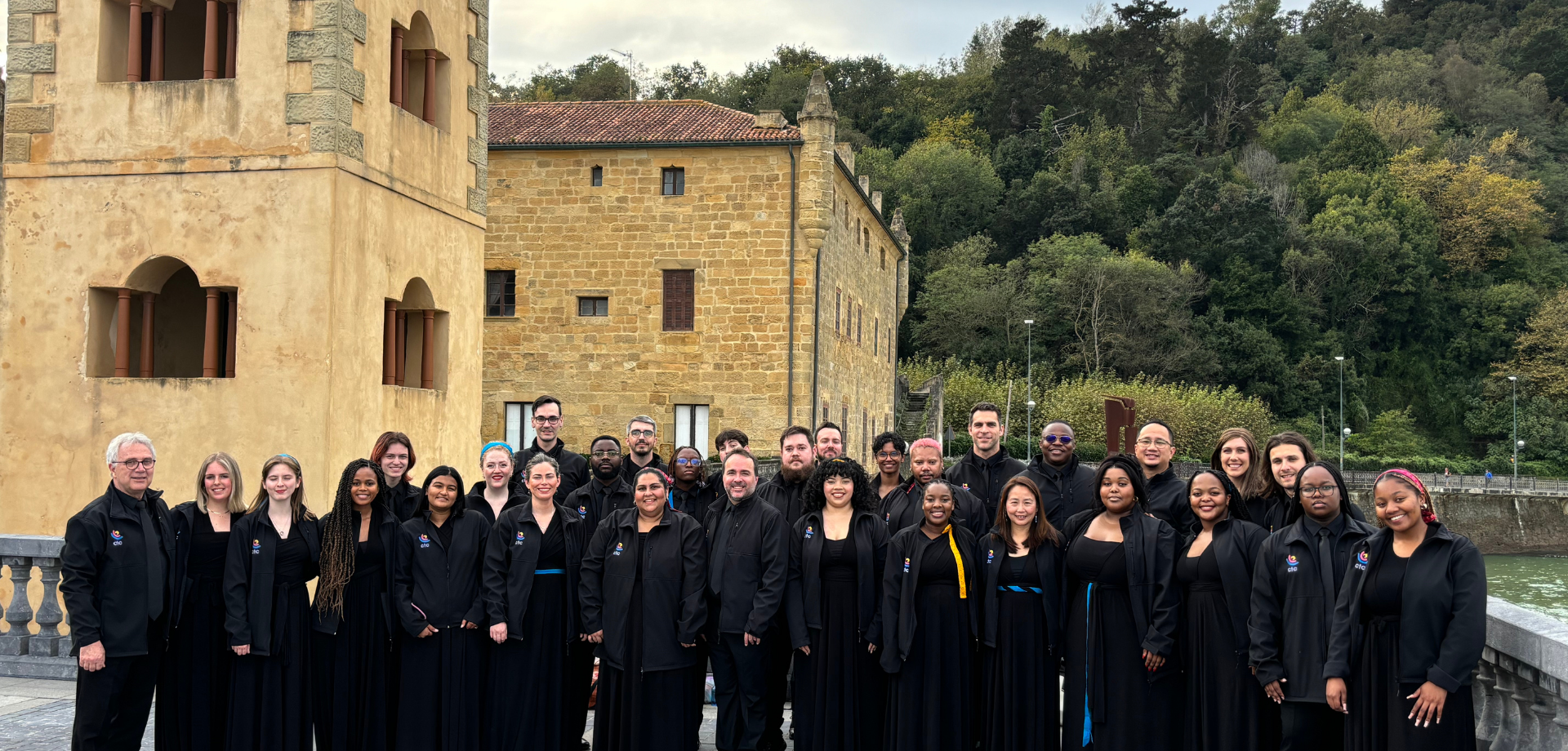
We started in 1997 as the Cape Town Youth Choir. Our singers grew up… and kept singing. Today, Cape Town Camerata spans high school students to adults in their 40s, all sharing the same stage, the same passion, and the same purpose.
We’re an NPO. We’re self-governing. We’re proudly South African. And we’re, quite simply, a happy place.
Upcoming PERFORMANCES
Come and hear us live in concert.
Your voice belongs here.
Membership is by audition and open to everyone, from matric to midlife. No experience of competitive auditioning required, just genuine love of singing and commitment to the process.
Audition.
Open to all voice parts. We hold auditions twice a year. Short, relaxed, and focused on fit.
Rehearsals
Twice a week in Cape Town. Two hours. Every session ends with something made beautiful together.
Tours & Collabs.
We’ve sung in Boston, London, and across South Africa. The world is the stage.
Family.
We train together, sing together, travel together and make memories together.
Hear Us Sing
Over thirty voices.
Zero instruments.
KEEP LISTENING ⬇
WHAT PEOPLE SAY
Not just a concert.
It's a feeling.
"This choir is like a second family, where we all share a deep love for music and a spirit of adventure."
Axel Lwala, Tenor
9 Years with CTC
"How does one listen to this beautiful music and avoid tears streaming down one's face? I can't!"
Alton C. Thompson
YouTube Subscriber
"CTC has given me an incredible creative outlet to balance the stress and intense studying that comes with being a medical student."
Karin Harrison, Soprano
7 Years with CTC
0
years of joy
0
unique voices
0
countries toured
0+
yearly performances
SUPPORT CTC
Keeping the joy alive!
We’re an NPO. No government grants, no corporate safety net. Just music, community, and people who believe in what we do.
Support from our community means we can continue to spread he joy of music far and wide. As a patron of Cape Town Camerata, you become part of the story.
Support Directly
FNB; Cape Town Youth Choir; Acc: 623 995 444 70; Sea Point Branch: 201 809; SWIFT: FIRNZAJJ
Become a Patron
Hear our latest music and support us monthly, with membership tiers starting at just R50p/m.
Support with Paypal
We gratefully accept donations via our paypal account:
paypal@ctyc.co.za
FROM THE PODIUM
The Monthly Pitch
Giving Voice to Liturgical Latin in it’s Authentic Resonance
Published in 1961 The Liber Usualis, “gives a brief summary of all the Rules for the proper execution and interpretation of the Vatican edition of the Roman Chant, according to the Solesmes Method”.
The text was created as a means to provide guidelines for the proper and correct way of singing Gregorian chant in the Catholic tradition. “Certainly in the course of time the Gregorian Chant incurred no small loss of purity. … And then appeared the Decree of the Congregation of Sacred Rites on January 8th, 1904, wherein clearer directions were given for the restoration of the Gregorian Chant.”
The rules in this work have been “worked out and co-ordinated by the Benedictine monks of the Solesmes Congregation” and are based on the ancient Manuscript Records. It deals primarily with the rules, usage, and interpretation of Gregorian Chant in the Catholic tradition. An entire subsection is dedicated to the “reading and pronunciation of liturgical Latin.”
As a preface to the rules of pronunciation: “The correct pronunciation of Latin words, vowels, and consonants is a rock of offence to many people. We are not here concerned with the delicate question of pronunciation in the Classical period, but only with the pronunciation of the living liturgical Latin of the Church. Our aim, in compliance with the wishes of his holiness Pius X, is to pronounce and speak Latin in the Roman Style so eminently suited to Plainsong. For our purposes the vitally important element in this style is the rich, open, warm sounds of the vowels A and U. The other elements will, to be sure, receive our close attention; this one is primary and indespensable.”
Each vowel has one sound; a mixture or sequence of sounds would be fatl to good Latin pronunciation.
A pronounced as in Father, never as in the word can especially when A is followed by M or N as in Sanctus, Nam etc
E as in Red, men, met; never with the suspicion of a second sound as in Ray
I as in Feet, never as i in milk or tin
O as in For, never as in Go
U as ooin Moon, never as in Custom
Y is pronounced and treated as the Latin I
As a general rule when two vowel come together each keeps its own sound and constitues a separate syllable:
Diei would be dee-e-ee and not day-ee
Filii would be fee-lee-ee
Eórum is e-ó-rum.
Prout would be pro-oot
Coutuntur would be co-oo-toon-toor
Ait would be ah-eet
AE and OE are pronounced as one sound, exactly like E. E.gl. caelum is pronounced like celum
In AU, EU, and AY, both vowels must be distinctly heard. The principle emphasis and interest belongs to the first which must sound purely. If on such a syllable several notes are sung, the vocalisation is entirely on the first vowel, the second being heard only on the last note at the moment of passing to the following syllable.
Thus e.g. Lauda become la—uda
Euge become E—uge
EI is treated the same, e.g. Mei become Me—-i; except when it becomes an interjection. In “Hei”, the vowel goes to the “i” nearly immediately.
U preceded by Q or NG and followed by another vowel as in qui or sanguis, keeps its normal sound, but is uttered as one syllable with the vowel which follows: qui, que, quod, quam, sanguis.
But Cuiis pronounced koo-ee (There are some exceptions in certain Hymns)
C before e, ae, oe, i, y is pronounced like ch in church
Caelum = che-loom
Cecilia = Che-chee-lee-a
CC before e, ae, oe, i, y is pronounced t-ch
Ecce = et-che
Siccitas = seet-chee-tas
[Following the rules, the correct ecclesiastical pronunciation of caeser would be che-ser. In classical latin it woule be pronounced ke-ser. “Sea-ser” is an anglisized pronunciation]
SC before e, ae, oe, i, y is pronounced like sh in shed
Descendit = de-shen-deet
In all other cases, C is alway pronounced like the English K
Caritas = kah-ree-tas
CH is always like K (even before E or I)
Cham = Kam,
Machina = ma-kee-na
G before e, ae, oe, i, y is soft as in generous
e.g. magi, genitor, Regina
Otherwise G is hard as in government
e.g. gubernato, vigor, ego
GN has the softened sound given to these letters in French and Italian
e.g. Signor, monsignor,
agnus = ah-nyoos
magnificat = mah-nyee-fee-caht
regnum = reh-nyoom
H is pronounced as K in nihil (nee-keel) and mihi (mee-kee). [In ancient books these two words are often written as nichil and michi.] In all other cases H is mute.
J is often written as I (e.g. Iesu).
It is treated as Y, forming one sound wih the following vowel
Jam = yam
Alleluia = al-le-loo-ya
Major = ma-yor
R must be slightly rolled. Care must be taken not to omit this sound. Care must be taken not to modify the quality of the vowel in the syllable preceding the R
Kyrie –> Not Keer-ee-e, but Kee-ree-e
Sapere -> not Sah-per-e, but sah-pe-re
Diligere -> not dee-lee-ger-e but dee-lee-ge-re
S is hard as in the English word sea but is slightly softened when between two vowels, e.g. misericordia
TI before a vowel and following any letter excep S, X, T is pronounce tsee
Patientia = pa-tsee-en-tee-a
Gratia = gra-tsee-a
Constitutio = con-stee- tu-tsee-o
Laetitia = le-tee-tsee-a
Otherwise T is like the English T
TH is always like the English T in tea
e.g. Thomas, catholicam
X is pronounced ks. It is slightly softened when coming between two vowels.
e.g. exercitus = ek-ser-chi-toos
XC before e, ae, oe, i, y is pronounced K-SH
e.g. Excelsis = ek-shel-sees
Before other vowels XC is pronounced with the sounds of the letters composing it:
e.g. excussorum = eks-coos-so-room
Z is pronounced dz
e.g. zizania = dzee-dza-nee-a
Al the other consonants (B, D, F, K, L, M, N, P, Q, V) are pronounced as in English.
Voce vita non discordet;
Adam of St. Victor, 1100ce
Cum vox viat non remordet,
Dulce est symphonia.
“When the voice of life does not disagree, when the voice travels and does not cause regret, sweet is the harmony.”